TRAUMA AWARENESS AND TRAUMA INFORMED CARE

Buy this course to unlock the videos and materials below.
24 weeks · 5 resources
What Is Trauma, and Why Does It Matter? Module Overview Welcome to Module 1 of the Professional Certificate in Trauma Awareness & Trauma-Informed Care. Before we can provide trauma-informed care, we must first understand what trauma is, how it develops, how people respond to it, and why the same experience can affect different people in very different ways. Trauma is not simply the event that happened to a person. It is the impact that an overwhelming, frightening, threatening or deeply distressing experience can have on the person's brain, nervous system, body, emotions, beliefs, behaviour, relationships and sense of self. This module provides the foundation for the entire programme. Participants will begin moving away from simplistic ideas about trauma and develop a more nuanced understanding of trauma as a whole-person experience.
When Survival Takes Over Module Overview In Module 1, we established that trauma is more than an event. We explored how overwhelming experiences can influence the way people think, feel, behave, relate and experience themselves. In Module 2, we go deeper into what happens inside the brain and nervous system when a person encounters threat—and what can happen when the systems designed to protect us remain activated long after the danger has passed. Trauma is not simply "in the mind." It involves the interaction of the brain, autonomic nervous system, endocrine system, body, emotions, memory and environment. For the trauma-informed practitioner, understanding these mechanisms is essential. It changes the way we interpret behaviour. A client who cannot concentrate may not simply be "unmotivated." A client who constantly scans the room may not simply be "paranoid." A client who becomes overwhelmed by a seemingly minor event may not simply be "dramatic." A client who shuts down during difficult conversations may not be "uncooperative." Their nervous system may be responding according to what it has learned about safety and threat. The central question of this module is: What happens to the brain and body when survival becomes the priority?
No resources added yet.
Trauma, the Nervous System and the Somatic Experience Module Overview In Module 2, we explored the traumatized brain and nervous system and examined what happens when the body's survival systems detect threat. In this module, we move from understanding the brain to understanding the body. Trauma is not experienced only as a thought or memory. Threat and prolonged stress can be accompanied by changes in heart rate, breathing, muscle tension, sleep, digestion, pain perception, energy, attention, immune and endocrine functioning, and overall physiological regulation. For many trauma survivors, the body may communicate distress before the person has words for what is happening. A client may say: "I don't know why, but my chest suddenly becomes tight." Another may say: "Whenever someone gets close to me, my whole body tenses." Another: "I feel exhausted all the time." Another: "I don't feel anything in my body." Another: "My mind knows I'm safe, but my body doesn't." This module helps practitioners develop the ability to listen to the body without overinterpreting it, pathologizing it or dismissing legitimate medical symptoms.
No resources added yet.
Understanding What the Person Had to Learn to Survive Module Overview In the previous modules, we explored trauma as a whole-person experience, examined what happens in the brain and nervous system under threat, and considered how traumatic stress may be experienced through the body. In Module 4, we turn our attention to behaviour. This is where trauma-informed practice begins to challenge some of our most deeply held assumptions. Why does someone become controlling? Why does someone constantly please other people? Why does someone run away from difficult conversations? Why does someone become aggressive when they feel rejected? Why does someone sabotage healthy relationships? Why does someone become emotionally numb? Why does someone need everything to be perfect? Why does someone repeatedly return to situations that hurt them? Why does someone use substances, pornography, food, work, sex, gambling or other behaviours to regulate themselves? A trauma-informed practitioner does not automatically excuse these behaviours. Instead, we become curious about their function. What is this behaviour protecting? What does this behaviour help the person avoid, obtain, control or regulate? What did this person have to learn in order to survive their environment? This module introduces participants to the concept of survival adaptations and explores how strategies that may once have been protective can become problematic when carried into a different environment.
No resources added yet.
The Childhood That Lives Inside the Adult Module Overview The first four modules have taken us from understanding trauma as an overwhelming experience, to understanding its effects on the brain and body, and then to recognizing the survival adaptations that can emerge from it. Module 5 now takes us to one of the most important areas in trauma-informed practice: Adverse Childhood Experiences — ACEs Childhood is a period of extraordinary neurological, emotional, relational and psychological development. During these years, children depend heavily on caregivers and their environment to provide safety, protection, emotional regulation, attachment, consistency and opportunities for healthy development. When a child repeatedly experiences abuse, neglect, instability, violence, loss or other forms of adversity, the effects may extend beyond the immediate experience. The child may begin adapting to the environment. Those adaptations can later influence: emotional regulation; attachment; self-esteem; relationships; behaviour; coping; learning; physical health; mental health; substance use; identity. This module explores ACEs comprehensively—but importantly, it also examines the limitations of ACE scores. An ACE score is not a diagnosis. It is not a prediction of someone's future. And it does not tell us everything about a person's childhood. A trauma-informed practitioner therefore asks not only: "How many adverse experiences did this person have?" but: "What happened, when did it happen, how did the child experience it, what did the child need, what helped them survive, and what happened afterward?"
No resources added yet.
The Relationships That Taught Us How to Feel, Trust and Belong Module Overview A child does not develop in isolation. From the earliest stages of life, human development occurs within relationships. Before a child can independently regulate emotions, interpret danger, understand relationships or develop a stable sense of self, the child depends on caregivers for protection, regulation, connection, consistency and meaning. This makes attachment one of the most important concepts in trauma-informed practice. When caregiving relationships are sufficiently safe and responsive, children gradually develop an internal expectation that: "I can have needs, and someone may respond." "The world can be predictable." "I can explore and return to safety." But when the very people a child depends on for safety are also frightening, rejecting, inconsistent, unavailable or abusive, development can become complicated. The child may have to solve an impossible problem: "I need this person to survive, but I am also afraid of this person." Module 6 explores attachment, attachment patterns, developmental trauma, relational safety and the ways early relationships can continue to influence adult emotional and interpersonal functioning. The goal is not to label people as "secure," "anxious" or "avoidant." The goal is to understand relational adaptations and help people develop greater flexibility, safety and agency.
No resources added yet.
How Trauma Changes, Adapts and Reappears Across Development Module Overview Trauma does not look the same at every age. A traumatic experience occurring at age 4 may be expressed differently from the same experience occurring at age 14, 34 or 74. The meaning of the experience, the person's developmental capacities, available support, biological maturity, relationships and social environment all influence how adversity is experienced and expressed. For the trauma-informed professional, therefore, age matters. A child may communicate distress through play, behaviour or regression. An adolescent may express distress through withdrawal, anger, risk-taking or identity struggles. An adult may present with anxiety, depression, addiction, relationship difficulties, chronic pain or difficulties regulating emotions. An older adult may present with grief, isolation, sleep disturbance, somatic complaints or resurfacing memories. The professional must learn to ask: "What does trauma look like at this developmental stage?" But also: "What else could explain what I am seeing?" This module examines trauma from infancy through older adulthood, exploring developmental vulnerability, trauma manifestations, transitions, cumulative experiences, resilience and opportunities for recovery.
No resources added yet.
When Trauma Becomes a Pattern of Living Module Overview The previous modules have progressively widened our understanding of trauma: Module 1: What trauma is. Module 2: What trauma can do to the brain and nervous system. Module 3: How trauma can be experienced in the body. Module 4: The survival adaptations that develop in response. Module 5: The impact of adverse childhood experiences. Module 6: Attachment and developmental trauma. Module 7: How trauma interacts with development across the lifespan. Module 8 brings these ideas together. Some people experience a single overwhelming event and recover with appropriate support. Others experience repeated, prolonged or interpersonal adversity, sometimes beginning in childhood and continuing across different stages of life. For these individuals, trauma may not be experienced as one isolated memory. It may influence: identity → relationships → emotional regulation → body → behaviour → beliefs → coping → sense of safety. This is the territory of complex and cumulative trauma. The trauma-informed practitioner must learn to recognize these patterns without reducing the person to their trauma. The person is more than what happened to them.
No resources added yet.
When Trauma Shapes the Mind: Understanding Trauma-Related Psychological Manifestations Module Overview Trauma does not always present as a clear memory of a terrible event. Sometimes it presents as: anxiety; depression; panic; irritability; emotional numbness; insomnia; intrusive thoughts; dissociation; self-harm; substance use; relationship difficulties; chronic shame; difficulty concentrating; unexplained emotional reactions. This is one of the most important shifts in trauma-informed practice: The symptom is real, but the symptom may not tell the whole story. A person may present with a psychiatric disorder, trauma-related symptoms, or both. Trauma may be a precipitating factor, maintaining factor, vulnerability factor, or contextual influence. It should not automatically be assumed to be the sole cause. This module therefore teaches participants to look beyond symptom labels and develop a biopsychosocial and trauma-informed formulation. The practitioner learns to ask: "What are the symptoms?" "What happened?" "What is happening now?" "What meaning has the person made of it?" "What maintains the difficulty?" "What protective adaptations are operating?" And importantly: "What requires psychiatric or medical assessment?"
No resources added yet.
When the Mind Disconnects to Survive Module Overview Dissociation is one of the most important—and frequently misunderstood—phenomena in trauma-informed practice. Some people experience trauma through overwhelming emotions, intrusive memories and hyperarousal. Others appear to experience the opposite: emotional numbness; feeling disconnected from themselves; "spacing out"; losing track of time; feeling unreal; feeling detached from their body; difficulty accessing memories; functioning automatically without feeling fully present. For some individuals, dissociation may have developed as a way of managing experiences that felt overwhelming, inescapable or impossible to integrate at the time. The person may not consciously decide: "I am going to disconnect now." The experience may occur automatically. However, dissociation is not synonymous with trauma, and not every unusual memory experience or feeling of detachment should be interpreted as dissociation. This module therefore combines trauma-informed understanding with careful clinical reasoning. Participants will learn to distinguish ordinary absorption from clinically significant dissociation, understand dissociative symptoms, recognize the relationship between dissociation and trauma, assess safely, and respond without reinforcing fear, shame or false memories. The central principle is: Do not force the mind to remember what it may not be ready to remember. Help the person become safely present with what is happening now.
No resources added yet.
Trauma and addiction are deeply interconnected. Many people who struggle with substance use or other compulsive behaviours are not simply seeking pleasure; they may be attempting to regulate pain, escape overwhelming emotions, quiet intrusive memories, numb shame, create a sense of safety, or temporarily experience relief from an internal state they do not know how to manage. For the trauma-informed practitioner, therefore, addiction requires a question that goes beyond: “Why does this person keep doing this?” A more compassionate and clinically useful question is: “What is this behaviour doing for this person?” This module explores addiction through a trauma-informed lens while avoiding the assumption that trauma is the cause of every addiction. Addiction is multifactorial. Genetics, neurobiology, mental health, environment, social conditions, availability of substances, developmental experiences, personality, learning, stress and trauma can all contribute to vulnerability. The goal is to help practitioners understand the person beneath the behaviour.
The journey through this programme has progressively moved from understanding trauma to understanding how trauma affects the brain, body, emotions, behaviour, relationships, identity, spirituality, physical health and mental health. Module 12 now brings those strands together. Knowing about trauma does not automatically make someone trauma-informed. A practitioner becomes trauma-informed when their way of seeing, listening, communicating, assessing, formulating and intervening changes because of what they understand about trauma. Trauma-informed care therefore asks not only: “What is wrong with this person?” but also: “What has happened to this person?” “How has their experience shaped their adaptations?” “What does this person need to feel safe enough to heal?” and: “How can I help without taking away their autonomy or unintentionally retraumatizing them?” This module is the culmination of the programme and introduces participants to the practical application of trauma-informed principles across mental-health, counseling, therapeutic and pastoral settings.
No resources added yet.
rauma is not exclusively a psychological experience. It is a whole-person experience that can influence the brain, nervous system, endocrine system, immune system, cardiovascular system, metabolism, sleep, pain perception, reproductive health and patterns of health behaviour. For mental-health professionals, counselors, therapists and pastoral practitioners, understanding this connection is important because clients often present with physical symptoms long before they recognize that psychological distress may be contributing to their overall burden of illness. A person may present with: chronic pain; headaches; gastrointestinal symptoms; insomnia; persistent fatigue; palpitations; elevated blood pressure; metabolic difficulties; unexplained bodily sensations; recurrent healthcare visits; or worsening of an existing chronic condition. The trauma-informed practitioner does not conclude: “This is all psychological.” Nor should they conclude: “Trauma caused this disease.” Instead, the practitioner learns to ask: “How might psychological stress, trauma history, nervous-system dysregulation, health behaviours and biological vulnerability be interacting with this person's physical health?” This distinction is crucial. Trauma-informed care must never become trauma-blaming care.
No resources added yet.
Module 13 examined trauma and physical health broadly. This module goes deeper into one of the most important and increasingly studied areas of trauma science: the relationship between chronic stress, the nervous system, endocrine regulation, immune function, inflammation and chronic disease. The human body is constantly attempting to maintain balance. When a person encounters danger, the brain mobilizes systems that support survival. Heart rate changes. Hormones are released. Attention narrows. Energy is redirected. Immune activity is modulated. These responses are adaptive when they are proportionate and temporary. The difficulty arises when the body's threat systems are repeatedly activated by: chronic interpersonal conflict; childhood adversity; abuse; neglect; domestic violence; poverty; discrimination; unsafe environments; chronic illness; grief; occupational stress; or persistent psychological distress. Over time, repeated physiological adaptation may contribute to allostatic load, altered stress regulation and changes in immune and inflammatory processes. But this module requires an important scientific discipline: Association is not the same as causation. Trauma is not a universal explanation for chronic disease, autoimmune illness, diabetes, hypertension or cancer. The goal is to understand pathways of interaction, not to create simplistic mind-body explanations.
No resources added yet.
No resources added yet.
No resources added yet.
No resources added yet.
No resources added yet.
No resources added yet.
A trauma-informed professional does not need to be unaffected by suffering. In fact, complete emotional detachment may interfere with genuine therapeutic presence. The goal is regulated engagement. The practitioner learns to remain connected without becoming overwhelmed, compassionate without becoming consumed, and appropriately responsive without becoming reactive. This module therefore focuses on two closely related capacities: SELF-REGULATION The ability to notice and manage one's physiological, emotional, cognitive and behavioural state. PROFESSIONAL RESILIENCE The ability to adapt to professional stress, recover from difficult experiences, maintain effectiveness and continue meaningful practice without sacrificing personal wellbeing.
No resources added yet.
Trauma-informed care represents a fundamental shift in the way professionals understand, assess, communicate with, and respond to people who have experienced trauma. Rather than asking only, “What is wrong with this person?”, the trauma-informed practitioner learns to ask, “What may have happened to this person, how has it affected them, and what do they need in order to feel safe enough to heal?” This module marks an important transition in the programme. Participants have already explored trauma, adverse childhood experiences, attachment, trauma sequelae, mental-health presentations, addiction, physical health, self-exploration and the impact of trauma on the practitioner. They now begin translating that knowledge into professional practice. Trauma-informed care does not mean assuming that every client has experienced trauma. It means practicing in a manner that recognizes the possibility of trauma, minimizes the possibility of retraumatization, promotes safety and autonomy, and recognizes the strengths and survival adaptations of the individual. It is also important to distinguish trauma-informed care from trauma-focused treatment. A practitioner can provide trauma-informed care without providing specialized trauma-processing psychotherapy. Trauma-focused interventions require appropriate training, competence, supervision and professional authorization.
No resources added yet.
A trauma-informed professional does not simply possess knowledge about trauma. That knowledge must become visible in how the professional enters the room, asks questions, listens, interprets behaviour, conducts assessment, responds to emotional activation, establishes boundaries, develops treatment goals and closes the session. The clinical encounter is therefore not merely an assessment or intervention. It is itself a potential corrective relational experience. For some clients, sitting with a professional may activate previous experiences of: authority; judgment; abandonment; interrogation; powerlessness; rejection; betrayal; medical procedures; religious authority; institutional control. Consequently, the professional must learn to create an encounter in which the client retains appropriate voice, dignity, autonomy and choice while the practitioner maintains professional responsibility. This module introduces a structured Trauma-Informed Clinical Encounter Framework that participants can adapt to counseling, psychotherapy, mental-health practice, medical settings and pastoral counseling.
No resources added yet.
No resources added yet.
Module 24 is the capstone module of the six-month Trauma Awareness and Trauma-Informed Care programme. The previous modules have taken you through the entire trajectory of trauma: understanding trauma → understanding the brain and body → childhood adversity → attachment → trauma sequelae → mental health → addiction → physical health → self-exploration → trauma-informed care → integrative intervention. This final module brings everything together. The central question is no longer: “What is trauma?” or even: “What interventions are available?” The question becomes: “Can I now recognize trauma, formulate it appropriately, create safety, respond skillfully, manage my own reactions, select appropriate interventions, recognize my limitations and provide care without causing harm?” Module 24 therefore emphasizes integration, clinical reasoning, professional competence, ethical practice, supervised demonstration, reflective practice and lifelong development. It functions as the bridge between being educated about trauma and becoming a genuinely trauma-informed professional
No resources added yet.
The programme provides a comprehensive understanding of trauma, trauma responses, adverse childhood experiences, attachment and developmental trauma, trauma sequelae, trauma and mental-health disorders, trauma and addiction, trauma and physical health, and the ways traumatic experiences can shape behaviour, relationships, beliefs and identity.
Beyond understanding trauma in clients, participants are guided through a structured process of personal self-exploration, helping them recognize their own possible trauma imprints, triggers, survival patterns and professional blind spots. Mindfulness, meditation, journaling, somatic awareness and reflective practices are integrated throughout the programme.
The final phase focuses on trauma-informed care in practice, including psychological safety, trauma-sensitive communication, stabilization, grounding, case formulation, ethical boundaries, referral and appropriate use of integrative approaches such as Compassionate Inquiry, Cognitive Behavioural Therapy, Mindfulness-Based approaches and Somatic approaches.
What makes the programme different?
This is not simply a course about trauma.
It is a journey from:
Understanding Trauma → Understanding Yourself → Understanding Others → Developing Trauma-Informed Practice
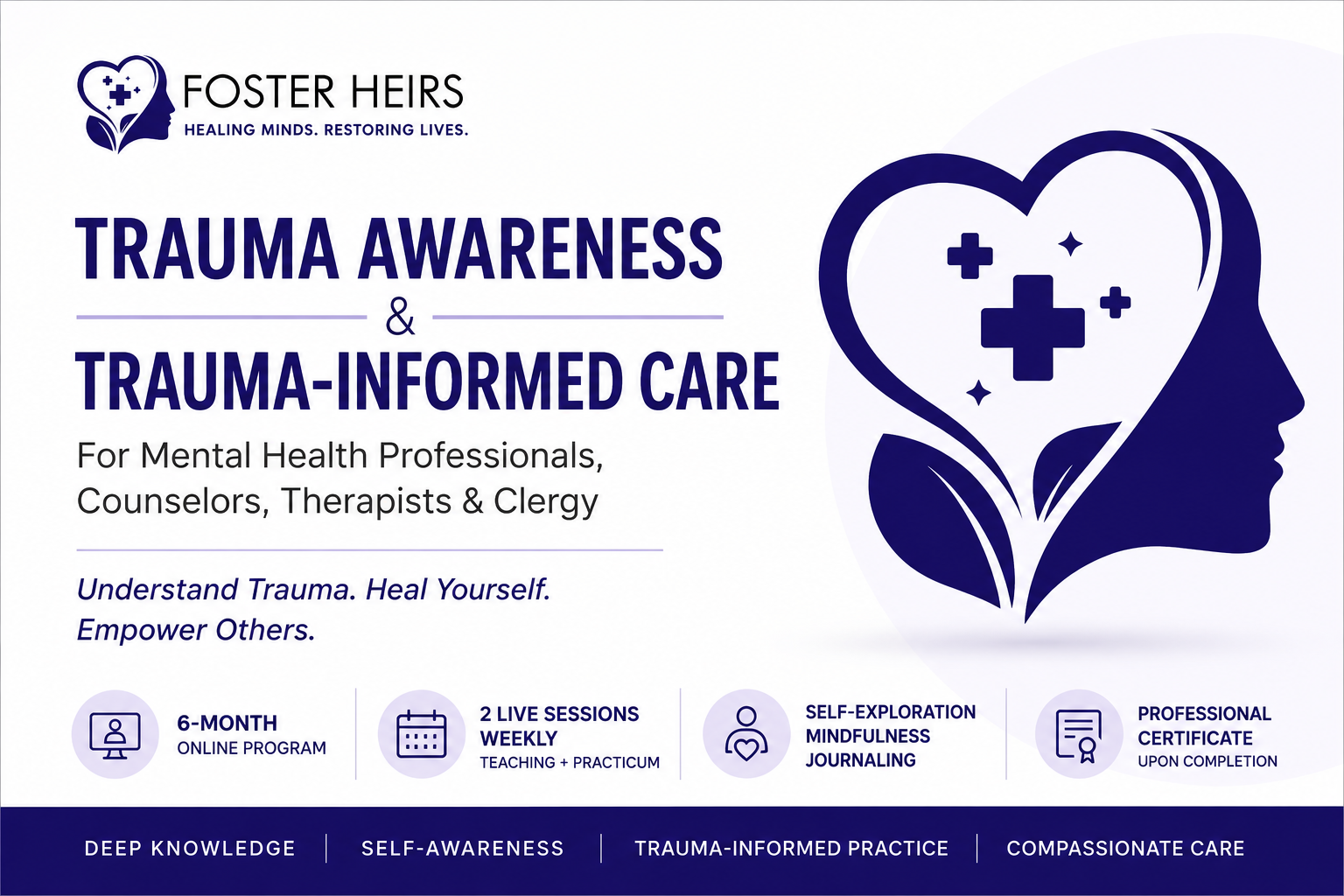
Participants receive two live online sessions every week:
Teaching Masterclass with the Lead Facilitator
Mandatory Interactive Practicum & Competency Session, including case discussions, demonstrations, skills practice, review and Q&A
The programme runs by cohorts, providing a structured learning community throughout the six months. It is not offered as an independent, self-paced course.
WHO CAN APPLY?
The programme is particularly suited to:
Counselors
Psychologists
Guidance and counseling professionals
Mental health therapists
Psychotherapists
Social workers
Mental-health nurses
Addiction counselors
Medical and allied health professionals involved in psychosocial care
Pastoral counselors
Clergy involved in pastoral counseling
Chaplains
Christian/faith-based counselors
Other appropriately qualified helping professionals
LEAD FACILITATOR
Dr. Anthonia Soje
Lead Therapist, Foster Heirs Mental Health Consultancy
Dr. Anthonia Soje is a Licensed Mental Health Counselor and Compassionate Inquiry Practitioner, with extensive professional interest in trauma, addiction, psychological recovery and whole-person mental health.
She is currently undertaking an advanced programme in Clinical Psychiatry, further strengthening her integration of mental-health counseling, psychotherapy and psychiatric knowledge.
Through Foster Heirs Mental Health Consultancy, she combines professional knowledge with an integrative approach to healing, drawing from Compassionate Inquiry, CBT, mindfulness-based approaches, somatic perspectives and trauma-informed practice.
JANUARY 2027 COHORT — APPLICATIONS NOW OPEN
Applications are now open for the January 2027 Cohort.
If you are a helping professional who wants to understand trauma more deeply, develop greater self-awareness and learn to provide safer, more compassionate and trauma-informed care, this programme is for you.
Duration: 6 Months
Format: Fully Online
Live Sessions: 2 per week
Mode: Cohort-based
Certificate: Professional Certificate upon successful completion
For enquiries and applications:
WhatsApp: 080-66-43-58-31
Send a WhatsApp message to begin your application.
FOSTER HEIRS MENTAL HEALTH CONSULTANCY
Healing Minds. Restoring Lives.
No reviews yet. Be the first to review this course.
A short registration is required before you can buy this course.
Have a coupon code?
- 24 weeks of content
- 5 video resources
- 4 course materials
- Certificate of completion
- 6 months access
TRAUMA AWARENESS AND TRAUMA INFORMED CARE