QUIT PORN AND SEX-RELATED ADDICTION: SELF RECOVERY COURSE

Buy this course to unlock the videos and materials below.
Course Materials
16 weeks · 21 resources
Lasting recovery is more than simply stopping an addictive behaviour. It involves understanding how addiction changes the brain, reshapes behaviour, and becomes reinforced by emotions, thoughts, trauma, and environment—and then intentionally creating new patterns that support healing. In this video, we explore the science behind addiction and the psychological principles that make sustainable recovery possible, because true freedom begins with understanding what keeps the cycle alive.
Porn and sex-related addiction is not simply a problem of weakness, immorality, or lack of self-control. It is a complex pattern involving the brain, emotions, thoughts, relationships, environment, and—within a faith-informed framework—spiritual life. In this part, we begin by understanding what pornography and compulsive sexual behaviours are, how they can become addictive patterns, why people get trapped in the cycle, and what makes genuine recovery possible. The goal is not shame, but understanding—because we cannot effectively heal what we do not understand.
Compulsive pornography use and sexual behaviours can engage the brain’s reward, motivation, learning, and stress systems, gradually strengthening neural pathways associated with craving and repetition. In this part, we explore dopamine, the reward circuit, conditioning, tolerance, cravings, impulse control, and the brain’s capacity for neuroplasticity—helping us understand why stopping can be difficult and why recovery is possible. When we understand what is happening in the brain, we can begin to change what has been happening in our lives.
How common are problematic pornography use and compulsive sexual behaviours—and who is most vulnerable? In this part, we examine the current statistics, prevalence estimates, and major biological, psychological, social, environmental, and relational risk factors associated with problematic pornography use and Compulsive Sexual Behavior Disorder (CSBD). We also explore how factors such as trauma, emotional dysregulation, impulsivity, loneliness, mental health difficulties, easy access to sexual content, and unhealthy coping patterns can contribute to the development or maintenance of the cycle. Understanding the risk factors is not about assigning blame—it is about identifying where prevention, intervention, and healing can begin.
Recovery is strengthened not only by reducing risk factors, but by deliberately building protective factors that support self-control, emotional regulation, healthy relationships, purpose, and resilience. Research points to the value of social support, adaptive coping, self-regulation, healthy connection, meaningful activities, and appropriate professional support in reducing vulnerability to problematic sexual behaviours. In this part, we explore how to build a life that makes recovery sustainable—strengthening the mind, nurturing healthy relationships, developing healthier ways to manage emotions and stress, establishing boundaries, cultivating spiritual resilience, and creating accountability and support systems. Recovery becomes stronger when we don't simply remove the unhealthy pattern—we build something healthier in its place.
Pornography and compulsive sexual behaviours can affect far more than sexual behaviour itself. In this part, we examine their potential impact across the biological, psychological, relational, social, occupational, and spiritual dimensions of life—including shame, emotional distress, impaired concentration, relationship difficulties, reduced intimacy, sexual wellbeing concerns, and disruption of personal responsibilities. We also explore an important distinction: not every person who consumes pornography has an addiction, and the evidence around specific effects remains complex. The focus is therefore on understanding when sexual behaviour becomes problematic, what consequences may emerge, and why addressing the underlying cycle matters for meaningful recovery. What begins as a private behaviour can eventually influence the way a person thinks, feels, relates, works, and lives.
Compulsive sexual behaviour often develops as a repeating cycle rather than a single event—with triggers and cues leading to craving, engagement in the behaviour, temporary relief or reward, followed by consequences such as guilt, shame, distress, or renewed attempts to stop. Over time, reinforcement and learned associations can make the cycle increasingly automatic and difficult to interrupt. In this part, we examine the different phases of the cycle, how the pattern becomes reinforced, where intervention can occur, and how recognising your personal cycle becomes an important first step toward breaking it. You cannot interrupt a cycle you cannot recognise.
Quitting begins with interrupting the cycle before the urge becomes an action. In this part, we explore practical first-aid strategies for managing triggers and cravings—such as removing access and cues, changing your environment, delaying the behaviour, distracting yourself, reaching out to a trusted person, and learning to ride out an urge without acting on it. These are first-response tools, not a substitute for deeper recovery work or professional therapy. The goal is to help you survive the immediate moment while you begin addressing the deeper emotional, psychological, relational, and spiritual roots of the pattern. You don't have to defeat the addiction forever today. Sometimes, recovery begins with simply winning the next few minutes.
Lasting recovery requires more than simply trying harder or avoiding triggers. In this part, we introduce a fourfold approach that addresses the biological, psychological, social, and spiritual dimensions of recovery—recognising that these areas interact and can each become pathways toward meaningful change. We explore how to heal the brain and body, transform thoughts and emotional patterns, rebuild healthy relationships and accountability, and strengthen faith, values, meaning, and purpose. This integrated approach helps move recovery from merely stopping the behaviour to building a healthier, freer, and more purposeful life. You don't just quit the behaviour—you rebuild the person, relationships, and life around it.
Recovery begins partly in the brain and body. In this part, we explore the biological foundations of recovery—including the reward system, cravings, stress responses, sleep, physical health, neuroplasticity, and factors that influence impulse control and emotional regulation. Current evidence supports a holistic approach, with psychotherapy as a first-line treatment and biological interventions considered where clinically appropriate. The goal is not simply to resist the urge, but to help the brain and body gradually develop healthier patterns of regulation, reward, and response. Healing the brain is part of learning to live differently.
Breaking free requires more than resisting urges—it requires understanding and changing the thoughts, emotions, beliefs, triggers, and coping patterns that keep the cycle alive. In this part, we explore psychological tools including cognitive restructuring, emotional regulation, trigger identification, mindfulness, healthy coping, self-compassion, behavioural change, and relapse prevention. Evidence increasingly supports psychological approaches such as CBT and ACT for problematic pornography use, although the research base is still developing. The goal is to move from “How do I stop myself?” to “What is happening inside me, and how can I respond differently?” Lasting recovery begins when you learn to change not only what you do, but how you think, feel, and respond.
Recovery does not happen in isolation. Our relationships, family systems, friendships, social environment, culture, access to technology, and sense of belonging can either reinforce addictive patterns or provide powerful support for change. Research suggests that loneliness, relationship difficulties, and limited social support can be associated with problematic pornography use, while healthy connection and supportive relationships may offer protective benefits. In this part, we explore how to rebuild healthy relationships, establish accountability, create supportive communities, set boundaries around technology and social environments, repair relational wounds, and develop meaningful connections that sustain recovery. You don't recover from addiction by simply withdrawing from unhealthy connections—you learn to build a healthier life of connection, belonging, and accountability.
For many people, addiction is not only a battle of the brain, behaviour, or emotions—it can also become a crisis of identity, meaning, values, purpose, and relationship with God. In this part, we explore how spiritual restoration can support recovery through prayer, Scripture, repentance, forgiveness, grace, accountability, identity in Christ, purpose, and the rebuilding of a healthy relationship with God. Research on addiction recovery also suggests that spirituality, meaning, community, and spiritual practices can play a protective and supportive role, although spirituality should complement—not replace—evidence-based psychological and clinical care. The goal is not to use spirituality to create shame or condemnation, but to move from hiding to honesty, from shame to grace, and from bondage to a renewed sense of identity, purpose, hope, and freedom. True spiritual recovery is not simply learning to resist temptation—it is learning to live from a restored identity and a renewed purpose.
Recovery is not simply about achieving a period of abstinence—it is about learning how to remain free when triggers, stress, loneliness, emotional distress, or unexpected cravings arise. Relapse prevention approaches commonly focus on identifying high-risk situations, managing cravings, strengthening emotional regulation, developing healthy coping strategies, building accountability, and responding to lapses before they become full relapses. Current evidence supports psychological approaches such as CBT, ACT, and mindfulness-based interventions, although research in this area is still developing. In this part, we develop a personal relapse prevention plan—learning to recognise early warning signs, prepare for vulnerable moments, manage digital and environmental triggers, seek support promptly, and turn a lapse into an opportunity for learning rather than shame. A lapse does not have to become a relapse. Recovery becomes sustainable when you know what to do before, during, and after the moment of vulnerability.
You have reached the end of the course—but this is not the end of your recovery journey. It is the beginning of putting knowledge into practice. The 21-Day Recovery Challenge is designed to help you translate what you have learned into daily action: recognising triggers, strengthening healthy routines, managing cravings, practising emotional regulation, building accountability, nurturing your spiritual life, and making intentional choices that support freedom. Relapse prevention works best when recovery skills are practised and integrated into everyday life rather than left at the level of knowledge. And remember: 21 days is a starting point, not a magic finish line. Behavioural change usually takes longer and varies from person to person, so use these 21 days to build momentum and continue the work beyond the challenge. YOUR NEXT CHAPTER STARTS NOW. Learned. Reflected. Challenged. Equipped. Now—LIVE FREE.
Recovery is not merely a theory—it is something people live, experience, and achieve. In the Hall of Fame, you will hear the personal stories, testimonies, struggles, turning points, and victories of people who have confronted addiction and found their way toward healing and a healthier life. Personal recovery stories can offer hope, reduce shame and remind those still struggling that they are not alone. WATCH. LEARN. BE ENCOURAGED. BE INSPIRED. Their stories are a reminder: healing is possible, recovery is possible, and your story can change too
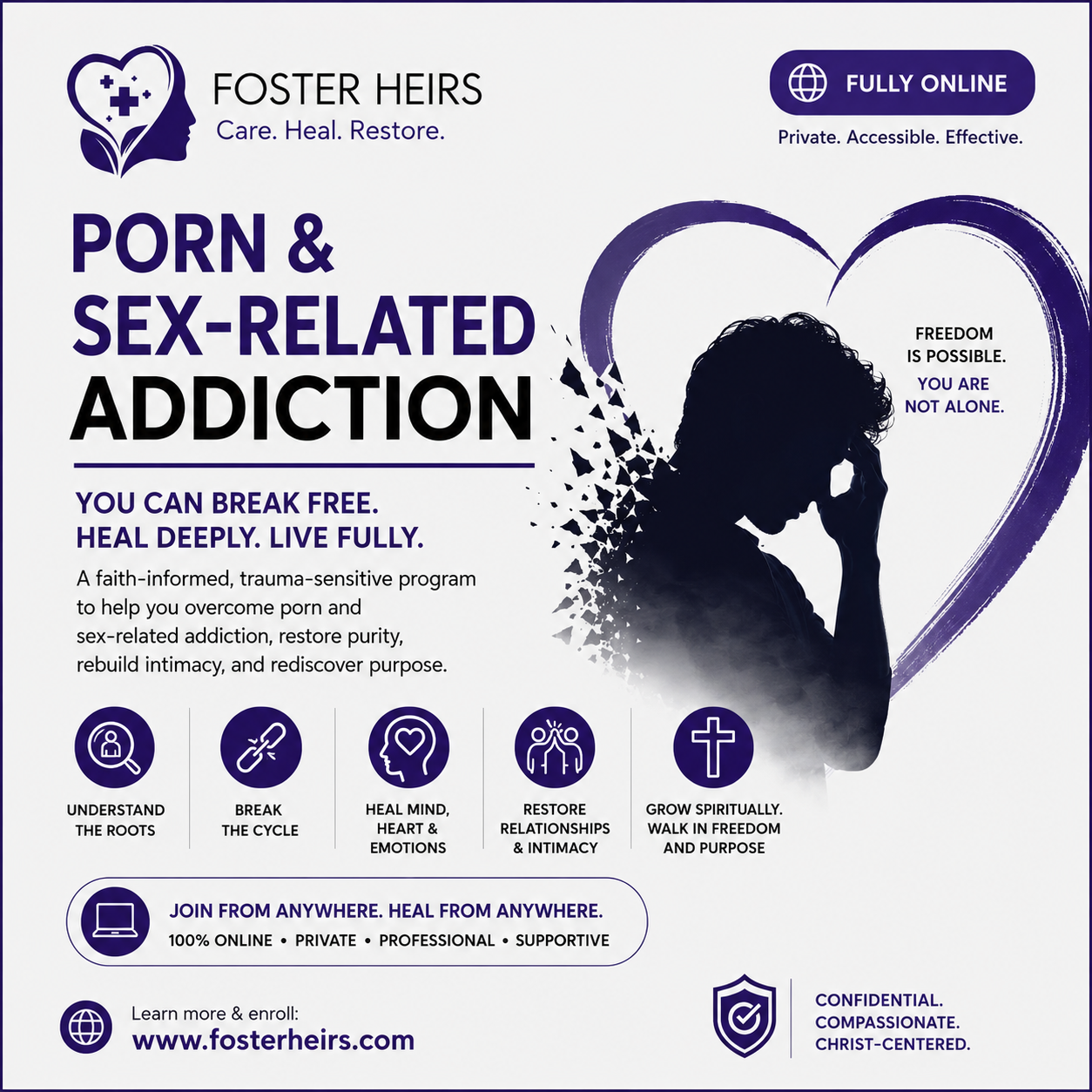
This is why Foster Heirs Mental Health Consultancy, under the leadership of Dr. Anthonia Soje, has developed a comprehensive addiction recovery course built around a Biopsychosocial-Spiritual approach—because lasting recovery requires more than simply stopping the behaviour. It requires understanding why the cycle began, what keeps it going, and how to build a life in which you no longer need it to survive.
THIS IS MORE THAN AN ONLINE COURSE.
It is a structured recovery journey designed to help you understand addiction, confront its roots, develop healthier coping mechanisms, restore your relationships, rebuild your identity, and rediscover purpose.
WHAT YOU GET
📚 2 CORE RECOVERY TEXTBOOKS
Go deeper beyond the videos with two carefully developed resources that serve as companions throughout your recovery journey:
The Addiction Compass — a guide to understanding the pathways, patterns, and roots of addiction.
Unshackled: A 30-Day Recovery Devotional — a daily faith-based journey designed to help you reflect, reconnect with God, and cultivate a life beyond addiction.
📝 14 MODULE-SPECIFIC WORKSHEETS
Every module comes with practical worksheets designed to move you from simply learning about recovery to actively doing the work of recovery.
Expect reflection, self-examination, pattern recognition, accountability, emotional processing, habit development, and intentional life rebuilding.
🎥 15 VIDEO TEACHING RESOURCES
Learn at your own pace through a structured series of video teachings that walk you through the key dimensions of addiction and recovery.
🏆 THE HALL OF FAME
Recovery is possible—and sometimes, you need to see it lived out.
The Hall of Fame features stories of people who have successfully navigated addiction and rebuilt their lives. Their stories serve as reminders that your current chapter does not have to become your permanent story.
A WHOLE-PERSON APPROACH TO RECOVERY
Our approach recognises that addiction affects—and is affected by—the whole person:
BIOLOGICAL — understanding the brain, body, cravings, reward pathways and physiological dimensions of addiction.
PSYCHOLOGICAL — exploring trauma, emotions, beliefs, coping mechanisms, thought patterns and the inner world.
SOCIAL — addressing relationships, isolation, family dynamics, accountability, community and healthy connection.
SPIRITUAL — exploring meaning, identity, faith, values, forgiveness, purpose and your relationship with God.
Because recovery is not simply about quitting something. It is about becoming someone who can live freely without returning to it.
AND WE STRONGLY RECOMMEND THERAPY ALONGSIDE THE COURSE.
Education can give you understanding.
A workbook can give you reflection.
A devotional can give you spiritual nourishment.
But sometimes, you need someone to walk with you into the places you cannot safely navigate alone.
That is why we recommend pairing this course with individual, one-on-one therapy.
Therapy provides a confidential space to explore the personal experiences, trauma, emotional wounds, relationship difficulties, triggers, shame, compulsions, and underlying patterns that may be keeping the addiction cycle alive.
THE COURSE TEACHES YOU THE MAP.
THERAPY HELPS YOU NAVIGATE YOUR TERRAIN.
You do not have to choose between learning and healing.
You can do both.
READY TO TAKE THE NEXT STEP?
Whether you are struggling with addiction yourself, trying to understand a loved one's struggle, or recognising that you need professional support to break a cycle that has gone on for too long, you don't have to figure it all out alone.
Enroll in the course and begin your structured recovery journey.
And if you would like to complement the course with one-on-one therapy at Foster Heirs Mental Health Consultancy, you can speak with our Executive Assistant to schedule or enquire about a therapy session:
📞 070 42 48 10 85
Confidential. Compassionate. Christ-centred.
Foster Heirs Mental Health Consultancy
Care. Heal. Restore.
Your addiction may be part of your story.
It does not have to be the end of it.
No reviews yet. Be the first to review this course.
Have a coupon code?
- 16 weeks of content
- 21 video resources
- 9 course materials
- Lifetime access
QUIT PORN AND SEX-RELATED ADDICTION: SELF RECOVERY COURSE