CERTIFICATE IN MIDWIFERY AND OBSTETRICS CARE

Buy this course to unlock the videos and materials below.
Course Materials
12 weeks · 145 resources
This module introduces participants to the fundamental principles of midwifery and maternal-newborn care. It establishes the knowledge, professional attitudes, and safety practices required before progressing to more advanced obstetric skills. Participants will explore female reproductive anatomy and physiology, pregnancy and fetal development, respectful maternity care, professional ethics, scope of practice, communication, infection prevention and control, documentation, clinical handover, and timely escalation of concerns. The central focus is developing a safe clinical mindset: understanding what is normal, recognizing what may be abnormal, working within one's competence, and knowing when to seek help. Know what is normal. Recognize what is abnormal. Act safely. Escalate early.
Week 2 introduces participants to the principles and practice of antenatal care, with emphasis on promoting maternal and fetal wellbeing throughout pregnancy. Participants will learn how to take a comprehensive antenatal history, assess maternal and fetal health, identify risk factors and danger signs, perform routine observations, provide appropriate health education, and support birth preparedness. The week emphasizes respectful woman-centred care, early recognition of complications, accurate documentation, effective communication, and timely referral or escalation when concerns are identified. Antenatal mindset: Ask. Listen. Assess. Recognize risk. Educate. Document. Escalate early.
This module introduces participants to the physiology and processes of normal labour and childbirth, from the onset of true labour through delivery of the baby and immediate postpartum care. Participants will learn about the stages of labour, the 5 Ps, maternal and fetal monitoring, labour progression, supportive care, pain management, infection prevention, preparation for birth, and recognition of deviations from normal labour. Emphasis is placed on respectful maternity care, clinical vigilance, working within professional scope, and early recognition and escalation of maternal or fetal complications. Support normal physiology. Monitor carefully. Recognize danger early. Escalate promptly.
Module 4 introduces participants to the recognition and initial response to life-threatening complications that may occur during pregnancy, labour, childbirth, and the postpartum period. Participants will learn to recognize emergencies such as postpartum haemorrhage, eclampsia, obstructed labour, shoulder dystocia, cord prolapse, uterine rupture, maternal sepsis, shock, fetal compromise, and maternal collapse. Emphasis is placed on rapid assessment, timely escalation, emergency communication, teamwork, safe supportive care, accurate documentation, and working strictly within professional scope. Emergency mindset: Recognize early. Call for help. Stabilize safely. Escalate without delay.
Week 5 introduces participants to the principles of postnatal care, focusing on the health, recovery, and wellbeing of the mother following childbirth. Participants will learn to assess the postnatal mother, monitor vital signs and uterine involution, recognize postpartum complications, support breastfeeding, provide hygiene and nutrition education, and promote emotional and psychological wellbeing. Emphasis is placed on early recognition of danger signs, respectful and supportive care, prevention of complications, accurate documentation, and timely escalation or referral when concerns arise. Postnatal mindset: Assess the mother. Support recovery. Promote bonding and breastfeeding. Recognize danger early. Escalate promptly.
Week 6 introduces participants to the principles of essential newborn care, focusing on the care of the baby immediately after birth and throughout the early neonatal period. Participants will learn about newborn assessment, thermoregulation, breastfeeding support, cord care, infection prevention, identification of danger signs, and recognition of common neonatal problems. Emphasis is placed on safe, respectful, family-centred care, early recognition of newborn illness, appropriate documentation, and timely escalation or referral when abnormalities are identified. Newborn care mindset: Keep the baby warm. Help the baby feed. Prevent infection. Assess carefully. Recognize danger early. Escalate promptly.
Week 7 introduces participants to common medical and obstetric conditions that can complicate pregnancy, labour, and the postpartum period. Participants will learn to recognize conditions such as anaemia, gestational diabetes, hypertensive disorders, infections, malpresentation, placenta-related disorders, and other pregnancy complications. Emphasis is placed on early identification of risk, appropriate monitoring, supportive care, patient education, accurate documentation, and timely referral or escalation when complications are suspected. Clinical mindset: Know what is common. Recognize what is dangerous. Monitor carefully. Escalate early.
Week 8 focuses on the recognition and initial response to emergencies affecting the mother and newborn during the intrapartum and early postnatal periods. Participants will learn to identify critical conditions such as severe bleeding, eclampsia, maternal shock, sepsis, fetal compromise, birth asphyxia, neonatal infection, respiratory difficulties, and other life-threatening situations. Emphasis is placed on rapid recognition, immediate communication, appropriate supportive care within scope, continuous monitoring, teamwork, emergency referral, and timely escalation to prevent avoidable complications and deaths. Emergency mindset: Recognize danger early. Act quickly. Support safely. Escalate without delay.
Week 9 focuses on the development and consolidation of essential clinical skills used in maternity and obstetric care. Participants will be introduced to procedures and practical techniques including maternal and fetal assessment, abdominal examination, monitoring labour, infection prevention, assisting with normal childbirth, postnatal assessment, newborn care, and safe emergency support. Emphasis is placed on competence, patient safety, informed consent, infection prevention, accurate documentation, appropriate supervision, and working within professional scope of practice. Practical skills will be reinforced through demonstrations, simulation, supervised practice, and clinical attachment. Clinical skills mindset: Prepare carefully. Perform safely. Maintain dignity. Know your limits. Document accurately.
Week 10 introduces participants to the principles of family planning, reproductive health, and informed reproductive decision-making. Participants will learn about contraceptive methods, fertility awareness, counselling, prevention of sexually transmitted infections, healthy birth spacing, preconception care, and respectful communication with individuals and couples. Emphasis is placed on informed choice, confidentiality, respect for reproductive rights, culturally sensitive counselling, recognition of contraindications and risks, appropriate referral, and working within professional scope of practice. Reproductive health mindset: Educate without judgment. Support informed choice. Protect confidentiality. Promote healthy spacing. Refer appropriately.
Week 11 provides participants with an opportunity to integrate the knowledge and skills acquired throughout the programme into supervised clinical practice. Participants will engage with real maternity cases under appropriate supervision, applying their skills in antenatal care, labour and delivery support, postnatal care, newborn assessment, emergency recognition, documentation, communication, and patient education. Emphasis is placed on clinical competence, safe practice, professional conduct, teamwork, accurate documentation, clinical reasoning, and timely escalation. Participants will also reflect on their clinical experiences and identify areas requiring further development before final assessment. Clinical mindset: Observe carefully. Assess systematically. Practise safely. Learn continuously. Escalate appropriately.
No resources added yet.
Week 12 brings the programme to completion through comprehensive revision, competency assessment, clinical skills evaluation, and final examination. Participants will consolidate their knowledge and practical skills across antenatal care, labour and childbirth, postnatal care, newborn care, obstetric emergencies, reproductive health, clinical procedures, and professional practice. Assessment will include written examination, practical/OSCE assessment, clinical logbook review, case-based evaluation, and oral/viva assessment where applicable. Participants who successfully meet the required academic and competency standards will proceed to certification. Final mindset: Know the knowledge. Demonstrate the skill. Practise safely. Think clinically. Know your limits. Care with excellence.
No resources added yet.
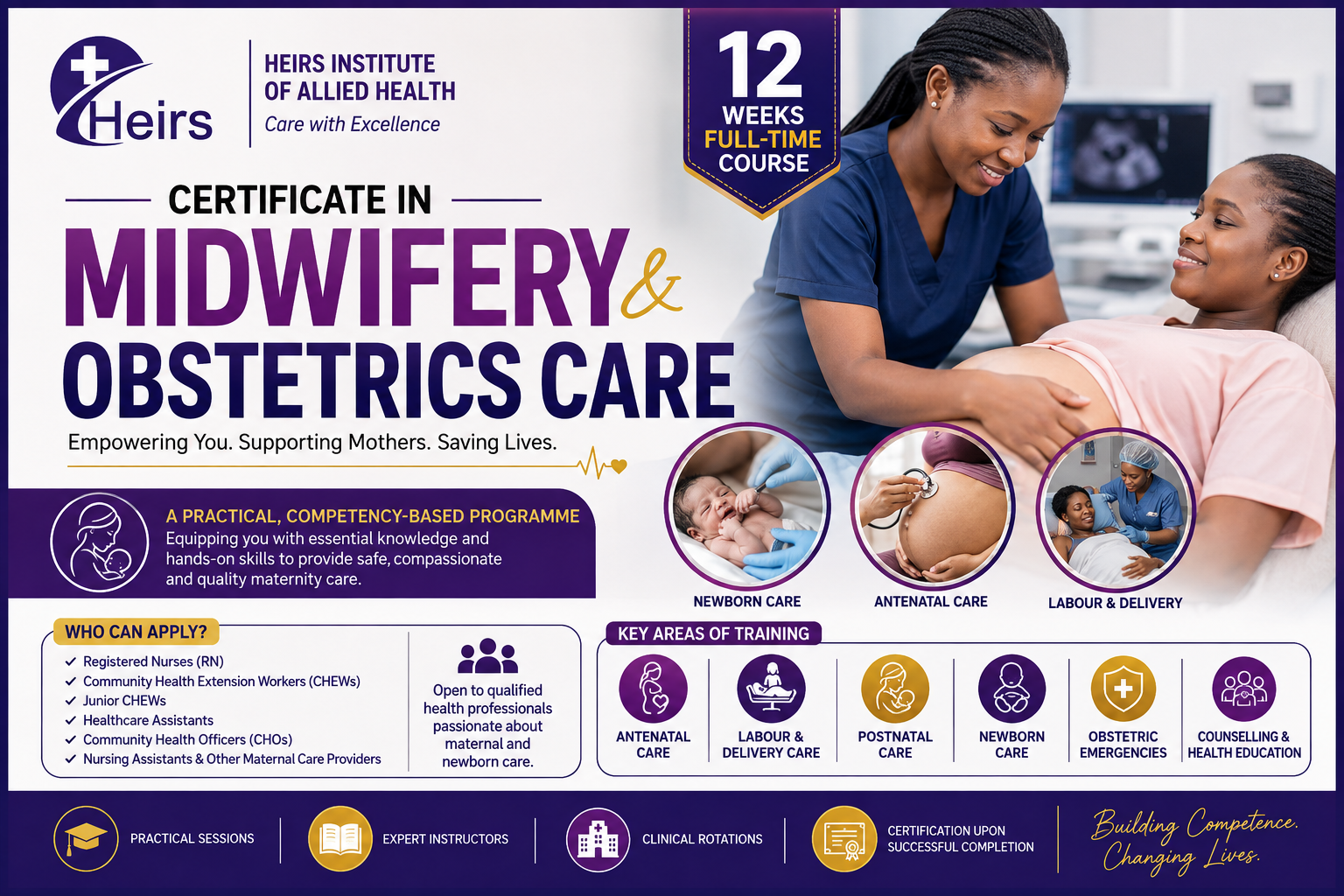
The Certificate in Midwifery and obstetrics care is a 12-week part-time, hybrid, competency-based programme designed to equip healthcare workers and eligible students with essential knowledge and practical skills in maternal and newborn care.
The programme combines online/classroom teaching, skills demonstrations, simulation-based learning, and supervised clinical practicum. Participants will gain practical competencies required to provide safe, respectful, compassionate, and evidence-based care throughout pregnancy, labour, childbirth, the postpartum period, and newborn care.
Key Areas of Training
Antenatal assessment and care
Labour monitoring and support
Normal childbirth and delivery support
Postnatal and maternal care
Essential newborn care
Recognition and initial management of obstetric emergencies
Infection prevention and control
Family planning and reproductive health
Maternal and newborn health education
Effective communication with mothers and families
Professional ethics and compassionate maternity care
Practical & Clinical Training
While the theoretical component is delivered through the hybrid learning format, participants will undertake hands-on skills practicums and supervised clinical attachment at Heirs Specialist Hospital, where they will have the opportunity to translate classroom knowledge into real-world maternity care under appropriate supervision.
Who Can Apply?
The programme is suitable for:
Registered Nurses
Registered Midwives seeking skills enhancement
Community Health Extension Workers (CHEWs)
Junior CHEWs
Community Health Officers (CHOs)
Healthcare Assistants
Nursing Assistants
Maternal and Child Health Workers
Other allied health professionals involved in maternal and newborn care
Traditional birth attendants
Students in relevant healthcare and health sciences programmes, particularly those seeking additional exposure to maternal and newborn care
Doctors are not eligible for this programme.
Certification
Upon successful completion of the required academic work, practical competencies, clinical attachment, assessments, and logbook requirements, participants will be awarded a:
DISCLAIMER: The certificate is a professional skills-development qualification and does not by itself confer statutory registration or licensure as a midwife where such registration is required by the relevant regulatory authority.
No reviews yet. Be the first to review this course.
A short registration is required before you can buy this course.
Have a coupon code?
- 12 weeks of content
- 145 video resources
- 11 course materials
- Certificate of completion
- 6 months access
CERTIFICATE IN MIDWIFERY AND OBSTETRICS CARE